Thursday, June 16, 2022

Second Beechcraft Denali first flight

The second Beechcraft Denali flight test article performed its first flight recently as momentum builds for the aircraft’s certification program. The milestone flight follows the Denali prototype, which completed its first flight in November.

The Beechcraft Denali is designed and manufactured by Textron Aviation Inc.

The aircraft’s flight lasted two hours and one minute, reaching a max altitude of 15,500 feet with a max speed of 240 knots true airspeed. To date, the program has accumulated more than 250 flight hours.

“The aircraft will be used primarily for testing aircraft systems like avionics, cabin environmental control and ice protection,” said Chris Hearne, senior vice president, Engineering & Programs.

The Denali flight test certification program is expected to eventually include a third flight test article and three full airframe ground test articles as it expands operational goals focusing on testing aircraft systems, engine, avionics and overall performance.

Engineered to achieve cruise speeds of 285 knots and full fuel payload of 1,100 pounds, the Denali is designed to have a range of 1,600 nautical miles at high-speed cruise with one pilot and four passengers and to be able to fly from Los Angeles to Chicago, New York to Miami or London to Athens.

The Denali is the first aircraft powered with GE’s Catalyst engine.

The cockpit features the Garmin G3000 intuitive avionics suite with high-resolution and touchscreen controllers.

The Beechcraft Denali’s flat-floor cabin is designed to be the largest in its segment and offers the versatility to easily convert between passenger and cargo configurations.

Monday, June 13, 2022

NASA ready to design spacecraft for Geospace Dynamics Constellation

NASA is moving forward with plans to develop six observatories designed to study the local and global effects of the Sun’s activity on Earth's high- and mid- latitude regions with a launch in the late 2020’s.

The Geospace Dynamics Constellation (GDC) project intends to publish the draft spacecraft Request for Proposal (RFP) in August and the final spacecraft RFP approximately three months later, NASA said in contract documents released Monday. Proposals are expected to be due 30 calendar days after the release of the final RFP.

GDC is a mission concept to study the coupling between the magnetosphere and the ionosphere/thermosphere system, and how that coupled system responds to external energy input.

GDC will address crucial scientific questions pertaining to the dynamic processes active in Earth’s upper atmosphere; their local, regional, and global structure; and their role in driving and modifying magnetospheric activity, according to the project's website. GDC will be the first mission to address these questions on a global scale due to its use of a constellation of spacecraft that permit simultaneous multi-point observations. This investigation is central to understanding the basic physics and chemistry of the upper atmosphere and its interaction with Earth’s magnetosphere, but also will produce insights into space weather processes.

In April, NASA selected three investigation teams to join the GDC mission science team as well as five additional investigations that will be under consideration for inclusion in the mission.

The three GDC investigations selected for flight have a combined budget of $149 million to design and deliver their instruments to the mission.

“GDC will greatly increase our understanding of and ability to mitigate the effects of space weather,” said Thomas Zurbuchen, associate administrator for science at NASA Headquarters in Washington, D.C. “What we learn from GDC is both critical for missions in low-Earth orbit, and a critical ingredient for understanding orbital debris in that domain.”

Planned for launch no earlier than September 2027, GDC will orbit in the same altitude range as the International Space Station, approximately 215 to 250 miles above Earth.

Sunday, June 12, 2022

Aha! airline begins nonstop service between Reno and Idaho Falls in August

Travelers can replace a lengthy nine-hour drive or painful layover with a quick 95-minute nonstop flight between Reno and Idaho Falls once aha! starts service on Aug. 11.

Aha!, powered by Express Jet Airlines, announced the added nonstop service on Thursday.

Aha! will fly to Idaho Falls Regional Airport two times a week with 50-seat Embraer ERJ145 regional jets. With the addition of Idaho Falls, aha! will now serve 11 cities nonstop from its home base at Reno-Tahoe International Airport.

Flights will operate each Thursday and Sunday departing Reno-Tahoe International Airport at 7:40 a.m. arriving at Idaho Falls Regional Airport at 10:15 a.m. Return flights will depart Idaho Falls at 10:55 a.m. and arrive in Reno-Tahoe at 11:30 a.m.

"We are thrilled to offer eastern Idaho residents with the opportunity to explore the incredible gaming, dining, shows, and indoor/outdoor fun of Reno and Lake Tahoe without lengthy drives or layovers," said Tim Sieber, head of ExpressJet's aha! business unit, in a press release. "The easy access to Yellowstone, the Greenbelt, museums and other treasures will surely attract a lot of Reno residents to Idaho Falls."

Currently, aha! connects ten markets to its home base in Reno-Tahoe: Fresno, Ontario, Palm Springs and Santa Rosa Calif.; Eugene/Springfield, Medford/Ashland and Redmond/Bend, Ore.; and Pasco/Tri Cities and Spokane, Wash.

Friday, March 11, 2022

ATF reviewing unmanned aircraft systems for the future

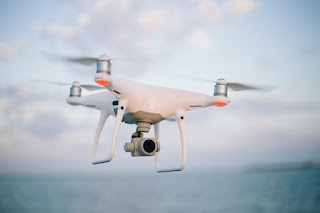
The Bureau of Alcohol, Tobacco, Firearms and Explosives (ATF) is presently conducting a review of the agency's Unmanned Aircraft Systems (UAS) and planning for future requirements. The review was announced in a Request For Information (RFI) contract document released Thursday.

The RFI was issued solely for market research, compiling information of available UAS sources and planning purposes. “It does not constitute an Invitation for Bids, Request for Proposal, or Request for Quotes,” the ATF said in the RFI.

The ATF is a law enforcement agency within the United States Department of Justice whose headquarters is located in Washington, D.C. The mission of ATF is to protect communities from violent criminals, criminal organizations, the illegal use and trafficking of firearms, the illegal use and storage of explosives, acts of arson and bombings, acts of terrorism, and the illegal diversion of alcohol and tobacco products.

Information provided in response to the RFI must be submitted to ATF contract officers no later than March 28.

In 2015, the ATF spent “approximately $600,000” on drones it never flew operationally, according to an audit conducted by a Justice Department watchdog.

The Department of Justice’s five law enforcement operational components conducted 248 UAS deployments during fiscal year 2020. All totaled, the components recorded approximately 172 hours and 59 minutes of flight time.

The general types or categories of missions flown include the following: authorized investigations, fugitive apprehension, communications support, search and rescue, site survey, counter-UAS testing and training, crime scene examination, mapping, reconnaissance of remote geographical areas, force protection and officer safety during service of warrants, demonstration flights, UAS and Counter-UAS testing and training, and production of component training videos.

Thursday, January 20, 2022

Engine overhauls ordered for Navy C-40A aircraft fleet

The Naval Air Systems Command, Tactical Airlift Program Office, Patuxent River, Md., is conducting market research to identify potential business sources with the resources, capabilities, and experience to successfully perform multiple C-40A engine overhauls beginning as early as 2025 and occurring over a three to five year period.

The C-40A aircraft is a Boeing 737-700C commercial-derivative cargo/transport/Extended Range Twin Engine Operations aircraft that is operated by the U.S. Navy and soon to be operated by the U.S. Marine Corps. The aircraft are equipped with CFM56-7B24 engines and have been modified with government unique items with supplement type certifications.

“At this time, the government anticipates 10 – 20 engine overhauls will be required over a three to five year period,” Navy officials said in contract documents. “Overhaul turn-around-time shall be 120 days between shipping to and shipping from the vendor.”

Wednesday, January 19, 2022

Radian Aerospace secures $27.5 million in funding to develop spaceplane

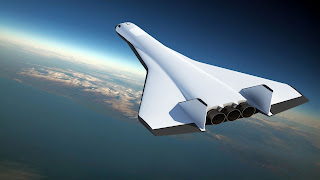
Radian Aerospace, developer of a fully reusable horizontal takeoff and landing, single-stage to orbit spaceplane, announced Wednesday that the company recently closed $27.5 million in seed funding. The recent round was led by Fine Structure Ventures, a venture capital fund.

The Radian spaceplane will “fill the efficiency and capability gaps that exist with traditional vertical rockets,” the company said in a press release. The vehicle will be capable of a wide range of space operations including the delivery of people and light cargo to low earth orbit with aircraft-like operations.

"To date, a low cost space transport solution has been lacking that can get humans and cargo to and from space at a highly responsive rate," said Brett Rome, venture partner at Fine Structure Ventures. "Radian is well positioned to fill that gap with disruptive technology that helps enable the emerging space economy."

The ability to fly to space, perform a mission, return, refuel, and fly again almost immediately enables in-space and terrestrial missions that are simply not possible with traditional vehicles, the company said.

"Wings offer capabilities and mission types that are simply not possible with traditional vertical takeoff right circular cylinder rockets," said Livingston Holder, Radian's co-founder and former head of the Future Space Transportation and X-33 program at Boeing. "What we are doing is hard, but it's no longer impossible thanks to significant advancements in materials science, miniaturization, and manufacturing technologies.”

“We are not focused on tourism, we are dedicated to missions that make life better on our own planet, like research, in-space manufacturing, and terrestrial observation, as well as critical new missions like rapid global delivery right here on Earth," said Richard Humphrey, CEO and co-founder of Radian.

The company already has launch service agreements with commercial space stations, in-space manufacturers, satellite, and cargo companies, as well as agreements with the U.S. government and selected foreign governments.

"We're talking about materially enabling an industry that's expected to grow to $1.4 trillion in less than a decade,” said Doug Greenlaw, a former chief executive of Lockheed Martin and one of Radian's investors and strategic advisors.

The addressable commercial market opportunity for Radian's disruptive launch vehicle is estimated to be $200 billion, the company said.

Tuesday, January 18, 2022

Third test flight for massive Stratolaunch experimental aircraft

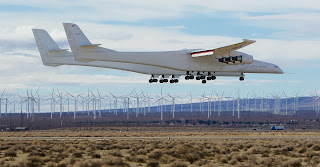
Stratolaunch LLC is excited to announce the successful completion of its third Roc carrier aircraft test flight on Sunday. Roc is the world's largest aircraft, with a 385-foot wingspan.

The aircraft took off at 11:47 a.m. EST and flew for 4 hours, 23 minutes over the Mojave Desert in California. It reached an altitude of 23,500 feet at an indicated air speed of 180 knots. This flight further prepared the carrier aircraft to support launches of its upcoming hypersonic testbed vehicle, Talon-A.

Launched from the Roc carrier aircraft, Talon-A vehicles are rocket-powered, autonomous, reusable testbeds carrying customizable payloads at speeds above Mach 5. This capability enables routine access to the hypersonic flight environment, which is critical for scientific research, technological development, and component demonstration.

"We will take the data we gathered and continue to advance the aircraft's operational performance to support hypersonic testing in 2022,” said Zachary Krevor, Stratolaunch president and chief operating officer in a company press release.

"The partial gear retraction seen during the flight is a graduated approach to building confidence in the landing gear and gear door hardware. Testing the left main landing gear individually mitigated risk and provided our aircrew with options for landing the aircraft in the event the hardware didn't perform as expected," Krevor said. "We'll review the data and determine when we can get back into the air to continue advancing our unique, hypersonic architecture."

The test flight included a low approach maneuver over the Mojave Air and Space Port.

In addition to testing the carrier aircraft, the team continues to make incredible strides in building its first two Talon-A test vehicles, TA-0 and TA-1. TA-1 completed its initial power-on testing in late December, keeping the company on track to begin hypersonic flight testing in 2022 and to deliver services to government and commercial customers in 2023.

Stratolaunch's mission is to advance high-speed technology through innovative design, manufacturing, and operation of world-class aerospace vehicles.