Showing posts with label museum. Show all posts

Monday, May 18, 2020

Army moving A-7D and MiG-21 aircraft to museum at Robins Air Force Base

The U.S. Army is relocating a few aircraft from their Aberdeen Proving Grounds facility in Maryland to the Museum of Aviation at Robins Air Force Base in Georgia, according to contract documents released last month.

The Army is looking for a contractor to provide aircraft relocation services to support the move. The scope of work for this project is to relocate one complete A-7D aircraft. One additional complete A-7D fuselage assembly, less main wing and horizontal stabilizers. Six complete and undamaged A-7D external fuel tanks. From the remaining A-7D aircraft remove the most serviceable components consisting of one intact A-7D canopy, one ejection seat, one heads up display, one radome, one complete set of external lights and one set of wingtip assemblies.

“These are historic aircraft and must be disassembled and moved with the purpose of reassembling the aircraft at the Museum of Aviation,” the Army said in contract documents. “All systems and components cannot be cut, torn or damaged during disassembly, transport and reassembly. All wiring, tubing, cables and attach points will be disconnected and reconnected at the reassembly location. The complete A-7D aircraft end product delivered must be completely reassembled and all systems and components reconnected and potentially fully functional. The A-7D fuselage will be delivered complete and on its landing gear. No other assembly is required. Exceptions may be considered by the end user and approved on a case by case basis. The six A-7D external fuel tanks will be delivered with storage cradles or fixtures.”

The A-7 Corsair II was a light attack bomber developed for the Navy by Ling-Temco-Vought Inc. in 1963 as a replacement for the A-4 Skyhawk. The A-7D is the Air Force version of the Corsair II. During the Vietnam conflict, the Air Force operated A-7Ds from bases in Thailand. The last combat missions for A-7s were flown by the Navy in Desert Storm in 1991.

In addition to the A-7D planes, the contractor will relocate one Russian MIG-21 aircraft and one MIG-21 crated R-29 engine from Aberdeen to the museum in Georgia. The MiG-21 is a supersonic jet fighter and interceptor aircraft designed by the Mikoyan-Gurevich Design Bureau in the Soviet Union.

Thursday, December 19, 2013

NASA's Orion spacecraft mockup stops in Tucson

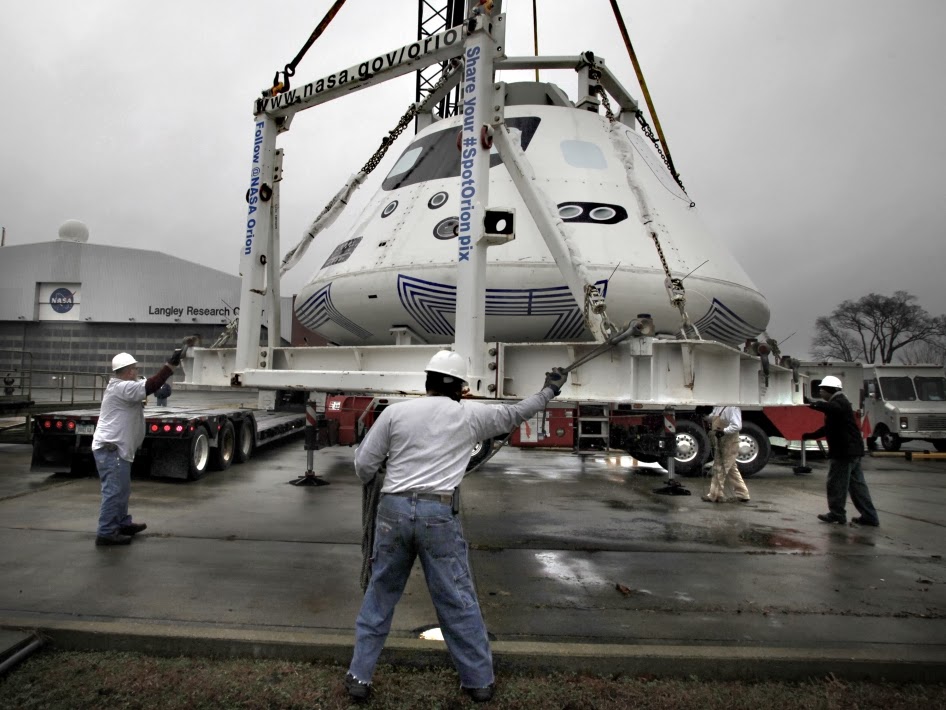
A test version of NASA's Orion spacecraft has been on a cross-country road trip for the past week, and it's taking a week-long rest stop in Tucson, Ariz, the space agency announced on Thursday.

Called “the boilerplate test article,” it is a structural mockup of the spacecraft NASA is building to take humans farther than they've ever been before that will be used in tests off the coast of San Diego in February. It left NASA's Langley Research Center in Virginia on Dec. 11 and has been making its way to California via truck since then. But the trip will pause for the holidays starting Thursday, and the test article will spend two weeks at the Pima Air & Space Museum in Tucson. The Orion test article is set to arrive at the museum between 3 p.m. and 5 p.m. MST.

Once it arrives Thursday, the test article will be available to be seen by the public for free for two hours outside of the museum. Afterward, it will be moved into a hanger inside the museum, where the public can see it with a museum ticket.

The test article will leave Tucson on Jan. 2 and arrive at the U.S. Navy's Naval Base San Diego by Jan. 7.

The 18,000-pound mockup is a full-sized replica of the Orion spacecraft currently being built at NASA's Kennedy Space Center. The mockup has already been used in a number of tests to ensure that Orion will be ready for its first mission, Exploration Flight Test-1, scheduled for September 2014. That mission will take Orion to 3,600 miles above the Earth's surface before returning it at speeds of up to 20,000 miles per hour for a splash landing in the Pacific Ocean.

In February, it will be used for an underway recovery test in the Pacific Ocean. For this test, the mockup will be set adrift in open and unstable waters, providing NASA and U.S. Navy the opportunity to recover the capsule and bring it into the well deck of the USS San Diego. While deployed, the team will seek out various sea states in which to practice the capsule recovery procedures. This will help build a knowledge base of how the capsule recovery differs in calm and rough seas and what the true physical limits are.

NASA and the Navy previously used this mockup to practice recovery in calm seas during a stationary recovery test in August where the spacecraft was set adrift in the waters of Naval Station Norfolk in Virginia and recovered into the docked well deck of the USS Arlington. The mockup was also dropped from 25 feet above the water of Langley's Hydro Impact Basin to simulate different splashdown scenarios.

Receive DCNewsroom email alerts, subscribe here.