
Showing posts with label mars. Show all posts

Friday, October 16, 2020

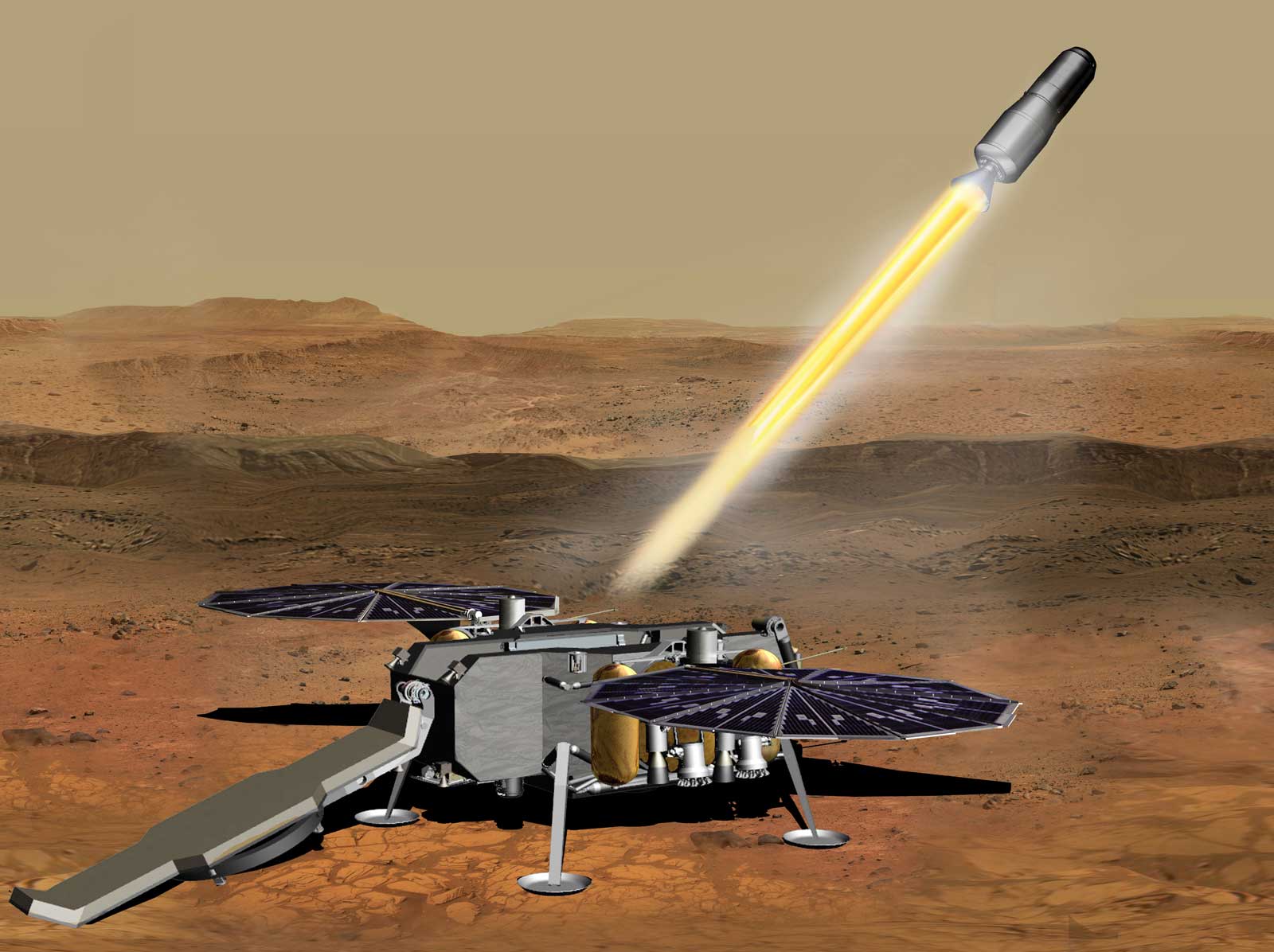
NASA begins work on radio transmitters for Mars Ascent Vehicle

NASA’s Marshall Space Flight Center (MSFC) in Huntsville, Ala., is soliciting information from potential sources for the manufacturing of Radio Frequency (RF) Transmitters for the Mars Ascent Vehicle (MAV). The space agency made the announcement in a Request For Information contract document released Thursday.

The MAV is one part of the Mars Sample Return Campaign and is a joint effort between MSFC and the Jet Propulsion Laboratory in Pasadena, Calif. The MAV is a vehicle designed to launch from the surface of Mars and will transport Mars samples taken from the Martian surface and launch the payload into orbit for rendezvous with an orbiting spacecraft. The Earth Return Orbiter (ERO) will rendezvous with and capture the payload from orbit, and bring it back to earth.

The MAV transmitter will transmit navigation and vehicle health data during the flight from launch until stage separation in order to aide in the capture of the released payload. The MAV has a downlink/transmit-only requirement for RF communications during the mission. There is currently no uplink/receive signal requirement. Therefore, only the manufacture of a device with data transmitting capabilities will be required. The transmitter will operate without any return link signal.  The transmitter will be required to operate solely in transmitting data mode during the first stage of the flight. The transmitter shall be able to switch between transmitting data mode, CW continuous mode, and CW pulse mode upon receiving a command from the flight computer.

RF Transmitter Specifications and Characteristics

  • Mode of Operation:  Transmit Data
  • Mode of Operation:  Carrier-only CW
  • Mode of Operation:  Carrier Pulses
  • Frequency:  401.585625 MHz
  • Information Rate (prior to any encoding applied):  8 kbps
  • Coded Symbol Rate (after all encoding applied):  16 kbps
  • Coding:  Convolution Coding, Rate = ½ ; Constraint Length = 7, non-inverted G2
  • PCM Data Encoding:  Bi-Phase-L (Manchester)
  • Symmetry of PCM Bi-Phase Waveform:  Mark-to-Space Ratio between 0.98 and 1.02
  • Necessary Bandwidth:  64 kHz

The RF transmitter will be required to tolerate environments of launch, 2.5 years of deep space cruise, Entry, Descent, and Landing, and a storage period of approximately one year on the Martian surface. Note that the RF transmitter will be in an unpowered state for a majority of the cruise except for short durations during health check-outs. For planning purposes, this requirement will involve the design, development, manufacture, testing, qualification, and delivery to NASA/MSFC of multiple RF transmitter units.  Due to the design configuration of the MAV, mass (minimal) is a key factor in determining the selected RF transmitter.

Organizations interested in supporting development of the RF transmitters should contact MSFC no later than Nov. 16.

Thursday, May 3, 2018

All systems are go for NASA's next launch to the Red Planet

The early-morning liftoff on Saturday of the Mars InSight lander will mark the first time in history an interplanetary launch will originate from the West Coast. InSight will launch from Vandenberg Air Force Base, Space Launch Complex 3E in California.

InSight, which stands for Interior Exploration using Seismic Investigations, Geodesy and Heat Transport, will launch aboard a United Launch Alliance Atlas V rocket. InSight will study the deep interior of Mars to learn how all rocky planets formed, including Earth and its Moon. The lander's instruments include a seismometer to detect marsquakes, and a probe that will monitor the flow of heat from the planet's interior.

The Atlas V rocket will carry the spacecraft over the Channel Islands just off the California Coast and continue climbing out over the Pacific. The rocket will reach orbit about 13 minutes after launch, when the rocket is about 1,200 miles (1,900 kilometers) northwest of Isabella Island, Ecuador.

Getting a Mars mission flying requires a great many milestones. Among those still to come are the official start of the countdown to launch -- which comes on Saturday at 1:14 a.m. EDT. A little over an hour later, at about 2:30 a.m. EDT, the 260-foot-tall (80-meter) Mobile Service Tower -- a structure that has been protecting the Atlas V launch vehicle and its InSight payload during their vertical assembly -- will begin a 20-minute long, 250-foot (about 80-meter) roll away from the Atlas.

InSight's landing on Mars is planned for Nov. 26, around 3 p.m. EST.

The Jet Propulsion Laboratory (JPL) in Pasadena, Calif., manages InSight for NASA's Science Mission Directorate. InSight is part of NASA's Discovery Program, managed by the agency's Marshall Space Flight Center in Huntsville, Ala. The InSight spacecraft, including cruise stage and lander, was built and tested by Lockheed Martin Space in Denver, Colo. NASA's Launch Services Program at the agency's Kennedy Space Center in Florida provides launch management. United Launch Alliance of Centennial, Colo., is NASA's launch service provider of the Atlas V rocket. A number of European partners, including France's Centre National d'Études Spatiales (CNES) and the German Aerospace Center (DLR), are supporting the InSight mission. In particular, CNES provided the Seismic Experiment for Interior Structure instrument, with significant contributions from the Max Planck Institute for Solar Systems Research. DLR provided the Heat Flow and Physical Properties Package instrument.

Video: First interplanetary mission launch from West Coast

Insight, NASA's next Mars explorer, has arrived at Vandenberg Air Force Base in California. The spacecraft is called InSight - short for Interior Exploration using Seismic Investigations, Geodesy and Heat Transport - and it's being tested, fueled and encapsulated for launch aboard the powerful United Launch Alliance Atlas V rocket. The upcoming liftoff will mark the first time an interplanetary mission has launched from the West Coast.

Tuesday, January 6, 2015

NASA announces new project scientist for Mars rover mission

The new project scientist for Mars Rover Curiosity is Ashwin Vasavada of NASA's Jet Propulsion Laboratory, Pasadena, Calif. Vasavada had been deputy project scientist for NASA's Mars Science Laboratory Project since 2004.

The project scientist's role is to coordinate efforts of an international team of nearly 500 scientists operating the rover's 10 science instruments, planning rover investigations and assessing data from the Curiosity rover.

Vasavada succeeds John Grotzinger of the California Institute of Technology, Pasadena, who recently became chair of Caltech's Division of Geological and Planetary Sciences and remains a member of Curiosity's science team.

"John Grotzinger put his heart and soul into Curiosity for seven years," Vasavada said.

Vasavada has helped shepherd the project through development of the spacecraft, selection and integration of the science instruments, selection of the landing site in Mars' Gale Crater, activities of Curiosity since its August 2012 landing, and publication of many research findings.

Researchers are currently using Curiosity to investigate the geological layers at the base of a mountain inside Gale Crater. Recent findings indicate that the lower portion of the mountain formed as sedimentary deposits in lakes and streams. During its two-year prime mission, Curiosity found evidence that Mars offered favorable conditions for microbial life about three billion years ago.

Vasavada has also worked on the science teams for NASA's Lunar Reconnaissance Orbiter and for the Cassini mission to Saturn. He holds a 1998 doctorate in planetary science from Caltech and a 1992 bachelor of science degree in geophysics and space physics from the University of California, Los Angeles.

Monday, August 5, 2013

NASA's next spacecraft going to Mars

NASA's next spacecraft going to Mars arrived Friday at the agency's Kennedy Space Center in Florida, and is now perched in a clean room to begin final preparations for its Nov. 18 launch.

The spacecraft was transported from Buckley Air Force Base in Aurora, Colo., on Friday, aboard a U.S. Air Force C-17 cargo plane. Lockheed Martin Space Systems in Littleton, Colo., designed and built the spacecraft and is responsible for testing, launch processing, and mission operations.

Known as MAVEN (Mars Atmosphere and Volatile Evolution), the spacecraft is undergoing detailed testing and fueling prior to being moved to the launch pad.

MAVEN will conduct the first mission dedicated to surveying the upper atmosphere of Mars. Scientists expect to obtain unprecedented data that will help them understand how the loss of atmospheric gas to space may have played a part in changing the planet's climate. Previous Mars missions detected energetic solar fields and particles that could drive atmospheric gases away from Mars. Unlike Earth, Mars does not have a planet-wide magnetic field that would deflect these solar winds. As a result, these winds may have stripped away much of Mars' atmosphere. Scientists will use MAVEN data to project how Mars became the cold, dusty desert planet we see today. The planned one-year mission begins with the spacecraft entering the Red Planet's orbit in September 2014.

In the next week, the team will reassemble components previously removed for transport. Further checks prior to launch will include software tests, spin balance tests, and test deployments of the spacecraft's solar panels and booms.


MAVEN's principal investigator, Bruce Jakosky, is based at the University of Colorado Laboratory for Atmospheric and Space Physics in Boulder. The university provides science instruments and leads science operations, education and public outreach. Goddard Space Flight Center manages the project and provides two of the science instruments for the mission. Lockheed Martin built the spacecraft and is responsible for mission operations. The University of California at Berkeley's Space Sciences Laboratory provides science instruments for the mission. NASA's Jet Propulsion Laboratory in Pasadena, Calif., provides navigation support, Deep Space Network support, and Electra telecommunications relay hardware and operations.

Receive DCNewsroom email alerts, subscribe here.