Northrop Grumman Corp. announced Monday that it has appointed Kevin Bell corporate lead executive for company business in Dayton. Bell reports to Timothy Jones, vice president, aviation and intelligence, surveillance and reconnaissance.
In his new role, Bell represents the company to customers in the Dayton region including those at Wright Patterson Air Force Base, the U.S. Air Force Research Laboratory and the Air Force Life Cycle Management Center.
Bell has supported Northrop Grumman customers in Dayton as a business development representative and a sector lead executive. Prior to joining Northrop Grumman, he served more than 26 years in the Air Force, retiring as assistant to the commander, Aeronautical Systems Center, Wright Patterson Air Force Base. His extensive and successful Air Force acquisition experience includes assignments as the senior acquisition adviser to the Office of Military Cooperation-Afghanistan, system program director for the KC-767 Aerial Refueling Tanker Lease Program and director of the F/A-22 Fighter Aircraft Engine Program.
Bell earned a bachelor's degree in business administration from Valdosta State College, Valdosta, Ga., and a master's degree in management from Troy State University, Troy, Ala. He also attended the Air War College, and Air Command and Staff College.
Monday, June 16, 2014
Students and educators visit Virginia's Eastern Shore to launch rocket
Students and educators from across the United States will become "rocket scientists" during a workshop at NASA's Wallops Flight Facility in Virginia this month.
The seventh annual RockOn! workshop, conducted in partnership with the Colorado and Virginia Space Grant Consortia, will provide 61 community college and university students and instructors the opportunity to learn how to build a scientific payload for a suborbital rocket flight.
During RockOn!, participants will learn the basics of experiment design including programming and electronics. The students will construct experiments to measure acceleration, spin rate, radiation, humidity, pressure and temperature during a rocket flight.
Their experiments, built in only three days, will then be incorporated into a rocket payload for launch on a Terrier-Improved Orion suborbital sounding rocket at 5:30 a.m. EDT June 26. After flying to nearly 70 miles in altitude, the payload carrying the experiments will land in the Atlantic Ocean where it will be recovered. The participants are expected to have their experiments in hand later in the day to begin data analysis.
In addition to the RockOn! experiments, a group of more complex experiments from the RockSat-C program also will be flying on the sounding rocket. These experiments are developed by students, many of whom have participated in a previous RockOn! workshop, from Mitchell Community College, Statesville, North Carolina; West Virginia University, Morgantown; Carthage College, Kenosha, Wisconsin; Temple University, Philadelphia; and Howard University in Washington.
About 50 students and instructors participating in RockSat-C will come to Wallops on Friday to begin their final experiment integration and to witness the launch.
In addition, more than 100 small cubes carrying experiments developed by pre-college students will launch with RockSat-C as part of the Cubes in Space program. Experiments vary from measuring changes in the electromagnetic field as the experiment moves through the ionosphere to determine whether the nano-computers would survive spaceflight, to observing the changes to the properties of a marshmallow as a result of the intense g-force of the launch. Cubes in Space is a partnership between Rubik Learning Initiative, idoodlesoftware inc. and the Colorado Space Grant Consortium.
The seventh annual RockOn! workshop, conducted in partnership with the Colorado and Virginia Space Grant Consortia, will provide 61 community college and university students and instructors the opportunity to learn how to build a scientific payload for a suborbital rocket flight.
During RockOn!, participants will learn the basics of experiment design including programming and electronics. The students will construct experiments to measure acceleration, spin rate, radiation, humidity, pressure and temperature during a rocket flight.
Their experiments, built in only three days, will then be incorporated into a rocket payload for launch on a Terrier-Improved Orion suborbital sounding rocket at 5:30 a.m. EDT June 26. After flying to nearly 70 miles in altitude, the payload carrying the experiments will land in the Atlantic Ocean where it will be recovered. The participants are expected to have their experiments in hand later in the day to begin data analysis.
In addition to the RockOn! experiments, a group of more complex experiments from the RockSat-C program also will be flying on the sounding rocket. These experiments are developed by students, many of whom have participated in a previous RockOn! workshop, from Mitchell Community College, Statesville, North Carolina; West Virginia University, Morgantown; Carthage College, Kenosha, Wisconsin; Temple University, Philadelphia; and Howard University in Washington.
About 50 students and instructors participating in RockSat-C will come to Wallops on Friday to begin their final experiment integration and to witness the launch.
In addition, more than 100 small cubes carrying experiments developed by pre-college students will launch with RockSat-C as part of the Cubes in Space program. Experiments vary from measuring changes in the electromagnetic field as the experiment moves through the ionosphere to determine whether the nano-computers would survive spaceflight, to observing the changes to the properties of a marshmallow as a result of the intense g-force of the launch. Cubes in Space is a partnership between Rubik Learning Initiative, idoodlesoftware inc. and the Colorado Space Grant Consortium.
Carbon dioxide monitoring satellite ready for launch
The launch of NASA's Orbiting Carbon Observatory-2 mission (OCO-2) at Vandenberg Air Force Base in California is scheduled for July 1. Liftoff from Space Launch Complex 2 aboard a United Launch Alliance Delta II rocket is targeted for 5:56 a.m. EDT.
OCO-2 is NASA's first mission dedicated to studying atmospheric carbon dioxide, the leading human-produced greenhouse gas driving changes in Earth's climate. OCO-2 will provide a new tool for understanding the human and natural sources of carbon dioxide emissions and the natural "sinks" that absorb carbon dioxide and help control its buildup.
NASA's Jet Propulsion Laboratory in Pasadena, Calif., is responsible for project management of OCO-2. Orbital Sciences Corp. built the OCO-2 spacecraft. NASA's Launch Services Program at the agency's Kennedy Space Center in Florida provides launch management. United Launch Alliance of Centennial, Colorado, is NASA's launch service provider for the Delta II rocket.
OCO-2 is NASA's first mission dedicated to studying atmospheric carbon dioxide, the leading human-produced greenhouse gas driving changes in Earth's climate. OCO-2 will provide a new tool for understanding the human and natural sources of carbon dioxide emissions and the natural "sinks" that absorb carbon dioxide and help control its buildup.
NASA's Jet Propulsion Laboratory in Pasadena, Calif., is responsible for project management of OCO-2. Orbital Sciences Corp. built the OCO-2 spacecraft. NASA's Launch Services Program at the agency's Kennedy Space Center in Florida provides launch management. United Launch Alliance of Centennial, Colorado, is NASA's launch service provider for the Delta II rocket.
Turkish Airlines orders 15 additional 737 planes
Boeing and Turkish Airlines on Monday finalized an order for 15 additional 737 MAX 8s, valued at $1.6 billion. The order follows the announcement in May 2013 when the Turkish carrier placed the largest Boeing order in the airline's history for 50 737 MAXs and 20 Next-Generation 737s.
With Monday's announcement, Turkish Airlines has more than 100 unfilled orders for Boeing airplanes; 65 737 MAXs, more than 25 Next-Generation 737s and 20 777-300ER (Extended Range) airplanes. The Istanbul-based carrier currently operates a fleet of more than 100 Next-Generation 737s and 15 777-300ERs.
The 737 MAX has surpassed 2,000 orders from 41 customers. The plane incorporates the latest-technology CFM International LEAP-1B engines. Airlines operating the 737 MAX will see an eight percent operating cost per seat advantage over tomorrow's competition.
Turkish Airlines currently serves 254 cities in 106 countries around the world from its base at Istanbul's Ataturk Airport.
With Monday's announcement, Turkish Airlines has more than 100 unfilled orders for Boeing airplanes; 65 737 MAXs, more than 25 Next-Generation 737s and 20 777-300ER (Extended Range) airplanes. The Istanbul-based carrier currently operates a fleet of more than 100 Next-Generation 737s and 15 777-300ERs.
The 737 MAX has surpassed 2,000 orders from 41 customers. The plane incorporates the latest-technology CFM International LEAP-1B engines. Airlines operating the 737 MAX will see an eight percent operating cost per seat advantage over tomorrow's competition.
Turkish Airlines currently serves 254 cities in 106 countries around the world from its base at Istanbul's Ataturk Airport.
Sunday, June 15, 2014
First scheduled transatlantic flight for WestJet
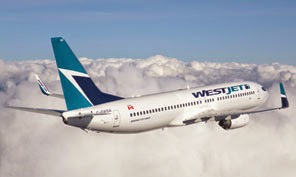
WestJet marks a key milestone in its 18-year history Sunday night with the launch of its first scheduled transatlantic service between Toronto and Dublin, Ireland, with a brief stop in St. John's, Newfoundland. The flight arrives in Dublin tomorrow at 7 a.m. local time.
Announced in November 2013, WestJet offered introductory fares between Toronto and Dublin starting from $199 on all flights in both directions from June 15 to Oct. 5 - fares which sold out within the first 24 hours. Today, the service is heavily booked and well ahead of projections, recently prompting a three-week extension to Oct. 25.
WestJet offer scheduled service to more than 85 destinations in North America, Central America, the Caribbean and Europe. Through their regional airline, WestJet Encore, the airline offers more than 120 destinations in more than 20 countries.
Announced in November 2013, WestJet offered introductory fares between Toronto and Dublin starting from $199 on all flights in both directions from June 15 to Oct. 5 - fares which sold out within the first 24 hours. Today, the service is heavily booked and well ahead of projections, recently prompting a three-week extension to Oct. 25.
WestJet offer scheduled service to more than 85 destinations in North America, Central America, the Caribbean and Europe. Through their regional airline, WestJet Encore, the airline offers more than 120 destinations in more than 20 countries.
Friday, June 13, 2014
Restaurants at Detroit Metro Airport could see layoffs in August
In
compliance with the Federal WARN Act (Public Law 100-379), HMS Host
Corp. notified Michigan's Workforce Development Agency that on or
about Aug. 15, the company will order layoffs at its Detroit
operations located at Detroit Metropolitan Airport.
“These
layoffs will occur as a result of a loss of contract and no new
contracts have been awarded to HMS Host at Detroit Metropolitan
Airport,” the company said in a letter received Thursday. “This
will result in a permanent closure of the Chili's Too, Jose Cuervo
Tequileria, Home Team Sports and the Starbucks Fountain. This is
expected to cause loss of employment for approximately 135 employees
unless the new contract holder decides to offer the displaced
associates new positions.”
Job
titles and number of affected employees
Union
Hourly Employees
- Utility worker: 12
- Hostesses: 5
- Cooks: 29
- Fast Food attendant: 4
- Servers: 39
- Bartenders: 19
- Barista: 8
Non-Union
Hourly/Salaried Employees
- Shift Supervisor 9
- Management 9
- Office Clerk 1
A deep look into the FAA's drone issue
The Federal Aviation Administration (FAA) is struggling to come up with regulations to control commercial drones in the country's airspace. But the rampant commercial usage of drones continues to cloud the issue, with the FAA asserting its authority without any clear regulations regarding the use of drones in American airspace.
The problem is that drones have quickly gone from being simple toys for hobbyists to new tools for everything from law enforcement to monitoring crops to social media to even getting amazing, cost-effective high-definition aerial shots for television and film production.
Journalists, commercial television producers and filmmakers are buying or building their own drone units for just a few thousand dollars, and are quickly creating a host of new problems about what is legal and what is not in an increasingly wider grey area of aviation law that involves not only airspace safety but questions about first and fourth amendment rights protections.
New York attorney Brendan Schulman will give a presentation about the FAA's drone issues Wednesday at the National Press Club in Washington, D.C. Schulman challenged the FAA for fining his client for using a drone to make a promotional commercial. He recently won the case, which was the first case of the FAA fining any business or individual for commercial use of a drone.
Also presenting will be Ben Gielow, general counsel and government relations manager at the Association for Unmanned Vehicle Systems International; and Parker Gyokeres, representing the recently-formed Professional Society of Drone Journalists.
The problem is that drones have quickly gone from being simple toys for hobbyists to new tools for everything from law enforcement to monitoring crops to social media to even getting amazing, cost-effective high-definition aerial shots for television and film production.
Journalists, commercial television producers and filmmakers are buying or building their own drone units for just a few thousand dollars, and are quickly creating a host of new problems about what is legal and what is not in an increasingly wider grey area of aviation law that involves not only airspace safety but questions about first and fourth amendment rights protections.
New York attorney Brendan Schulman will give a presentation about the FAA's drone issues Wednesday at the National Press Club in Washington, D.C. Schulman challenged the FAA for fining his client for using a drone to make a promotional commercial. He recently won the case, which was the first case of the FAA fining any business or individual for commercial use of a drone.
Also presenting will be Ben Gielow, general counsel and government relations manager at the Association for Unmanned Vehicle Systems International; and Parker Gyokeres, representing the recently-formed Professional Society of Drone Journalists.
Subscribe to:
Posts (Atom)