Showing posts with label orion. Show all posts

Wednesday, May 6, 2020

Boeing selects audio management system for new T-7A aircraft

Orbit Communication Systems Inc., a leading provider of airborne communications systems, announced Tuesday that Boeing selected its Orion Audio Management System (AMS) for the U.S. Air Force's new T-7A Red Hawk advanced pilot training system.

The Boeing T-7A is a purpose-built jet trainer specifically designed to provide advanced pilot training for future fighter and bomber pilots.

Orion is an innovative and highly resilient IP-based airborne audio management system designed to support diverse network-based communication products and applications. It is easily adapted across a broad range of airborne platforms, including helicopters, commercial airliners, mission aircraft, unmanned aerial vehicles and fighters.

Boeing selected the Orion AMS in the Engineering and Manufacturing Development phase of the project before the T-7A enters production. The initial program will include approximately 350 aircraft.

Friday, January 17, 2020

Honeywell awarded contract to support production of NASA's Orion spacecraft

Honeywell has been awarded a contract by Lockheed Martin to support production of NASA's Orion spacecraft fleet for the upcoming Artemis missions, which will send humans back to the moon for the first time since 1972. The contract to supply key components of the Orion crew module and service module will be managed and performed out of Honeywell's facility in Clearwater, Fla. Some work will also be conducted at the company's facilities in Glendale, Ariz. and Puerto Rico.

Honeywell will provide 14 products for Artemis missions III through V, including both hardware and software, to support NASA's lunar missions. NASA awarded Lockheed Martin a long-term multi-billion-dollar production contract for the Orion spacecraft, aimed to meet the space agency's anticipated needs into the 2030s.

Working in collaboration with the Orion team over the next decade, Honeywell will support Lockheed Martin and its partners through the development and production of essential guidance and navigation systems, command data handling, and display and control products.

Saturday, August 30, 2014

NASA's Orion spacecraft on the move toward maiden flight

NASA's new Orion spacecraft will be transferred from the Neil Armstrong Operations and Checkout Building to the Payload Hazardous Servicing Facility during the second week of September. The exact date will be announced as soon as possible, NASA said in a press release Friday.

In the Payload Hazardous Servicing Facility, the Orion spacecraft will be fueled with ammonia and hyper-propellants for its mission. It will later be moved again for the installation of its launch abort system.

Orion is undergoing preparations for its maiden flight in December, an unmanned flight that will take it 3,600 miles above Earth on a 4.5-hour mission to test the systems critical for future human missions to deep space. After two orbits, Orion will reenter Earth's atmosphere at almost 20,000 miles per hour before its parachute system deploys to slow the spacecraft for a splashdown in the Pacific Ocean.

The Orion spacecraft will carry astronauts farther into the solar system than ever before.

Tuesday, June 10, 2014

Orion's first trip into space six months away

With just six months until its first trip to space, NASA’s Orion spacecraft continues taking shape at the agency's Kennedy Space Center in Florida.

Engineers began stacking the crew module on top of the completed service module Monday, the first step in moving the three primary Orion elements –crew module, service module and launch abort system – into configuration for launch.

Orion's flight test will provide NASA with important data that will help the agency test out systems and further refine the design so they can safely send humans far into the solar system.

With the crew module now in place, the engineers will secure it and make the necessary power connections between to the service module over the course of the week. Once the bolts and fluid connector between the modules are in place, the stacked spacecraft will undergo electrical, avionic and radio frequency tests.

The modules are being put together in the Final Assembly and System Testing Cell in the Operations and Checkout Facility at Kennedy. Here, the integrated modules will be put through their final system tests prior to rolling out of the facility for integration with the United Launch Alliance Delta IV Heavy rocket that will send it on its mission.

Orion is being prepared for its first launch later this year, an unmanned flight that will take it 3,600 miles above Earth, in a 4.5 hour mission to test the systems critical for future human missions to deep space. After two orbits, Orion will reenter Earth’s atmosphere at almost 20,000 miles per hour before its parachute system deploys to slow the spacecraft for a splashdown in the Pacific Ocean.

Orion's flight test also will provide important data for the agency’s Space Launch System (SLS) rocket and ocean recovery of Orion. Engineers at NASA’s Marshall Space Flight Center in Huntsville, Alabama, have built an advanced adapter to connect Orion to the Delta IV Heavy rocket that will launch the spacecraft during the December test. The adapter also will be used during future SLS missions. NASA’s Ground Systems Development and Operations Program, based at Kennedy, will recover the Orion crew module with the U.S. Navy after its splashdown in the Pacific Ocean.

Thursday, June 5, 2014

Critical heat shield installed on NASA's new Orion spacecraft

NASA and Lockheed Martin engineers have installed the largest heat shield ever constructed on the crew module of the agency's new Orion spacecraft. The work marks a major milestone on the path toward the spacecraft's first launch in December.

The heat shield is made of a coating called Avcoat, which burns away as it heats up in a process called ablation to prevent the transfer of extreme temperatures to the crew module. The Avcoat is covered with a silver reflective tape that protects the material from the extreme cold temperatures of space.

Orion’s flight test, known as Exploration Flight Test-1, will provide engineers with data about the heat shield's ability to protect Orion and its future crews from the 4,000-degree heat of reentry and an ocean splashdown following the spacecraft’s 20,000-mile per hour reentry from space.

Orion's missions will include exploring an asteroid and Mars.

Orion's flight test also will provide important data for the agency’s Space Launch System (SLS) rocket and ocean recovery of the spacecraft. Engineers at NASA’s Marshall Space Flight Center in Huntsville, Ala., have built an advanced adapter to connect Orion to the United Launch Alliance Delta IV Heavy rocket that will launch the spacecraft during the December test. The adapter also will be used during future SLS missions. NASA’s Ground Systems Development and Operations Program, based at Kennedy Space Center in Florida, will recover the Orion crew module with the U.S. Navy after its splashdown in the Pacific Ocean.

The heat shield was manufactured at Lockheed Martin's Waterton Facility near Denver, Colo. Construction was completed at Textron Defense Systems near Boston, Mass., before the heat shield was shipped to the Operations and Checkout Building at Kennedy, where Orion is being assembled.

In the coming months, the Orion crew and service modules will be joined and put through functional tests before the spacecraft is transported to Kennedy’s Payload Hazardous Servicing Facility for fueling. The spacecraft then will be transferred to the Launch Abort System (LAS) Facility to be connected to the LAS before making the journey to Cape Canaveral’s Space Launch Complex 37 for pad integration and launch operations.

Thursday, December 19, 2013

NASA's Orion spacecraft mockup stops in Tucson

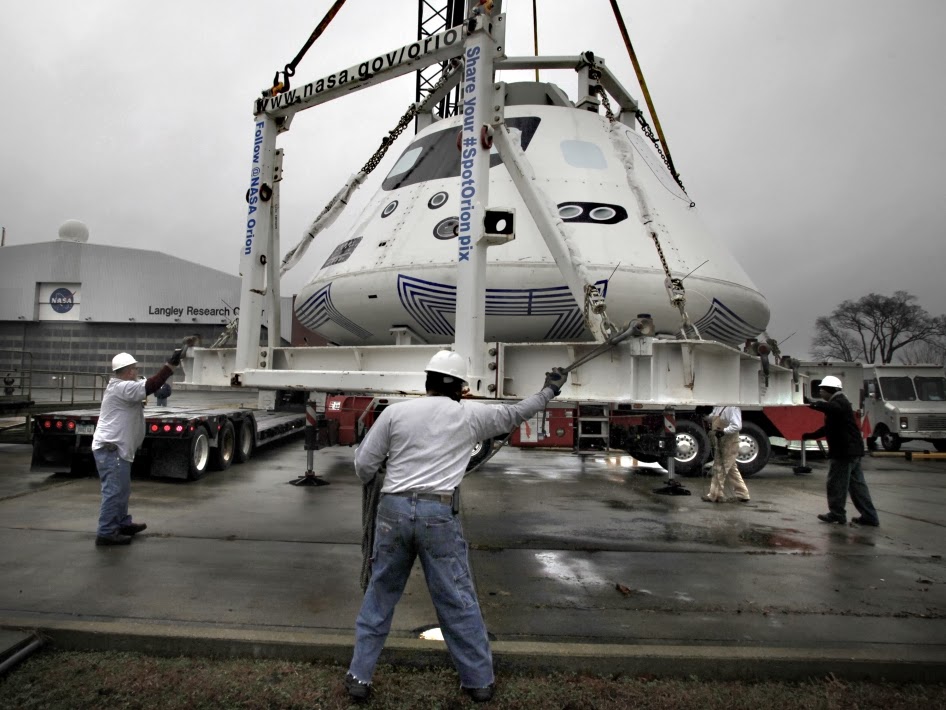
A test version of NASA's Orion spacecraft has been on a cross-country road trip for the past week, and it's taking a week-long rest stop in Tucson, Ariz, the space agency announced on Thursday.

Called “the boilerplate test article,” it is a structural mockup of the spacecraft NASA is building to take humans farther than they've ever been before that will be used in tests off the coast of San Diego in February. It left NASA's Langley Research Center in Virginia on Dec. 11 and has been making its way to California via truck since then. But the trip will pause for the holidays starting Thursday, and the test article will spend two weeks at the Pima Air & Space Museum in Tucson. The Orion test article is set to arrive at the museum between 3 p.m. and 5 p.m. MST.

Once it arrives Thursday, the test article will be available to be seen by the public for free for two hours outside of the museum. Afterward, it will be moved into a hanger inside the museum, where the public can see it with a museum ticket.

The test article will leave Tucson on Jan. 2 and arrive at the U.S. Navy's Naval Base San Diego by Jan. 7.

The 18,000-pound mockup is a full-sized replica of the Orion spacecraft currently being built at NASA's Kennedy Space Center. The mockup has already been used in a number of tests to ensure that Orion will be ready for its first mission, Exploration Flight Test-1, scheduled for September 2014. That mission will take Orion to 3,600 miles above the Earth's surface before returning it at speeds of up to 20,000 miles per hour for a splash landing in the Pacific Ocean.

In February, it will be used for an underway recovery test in the Pacific Ocean. For this test, the mockup will be set adrift in open and unstable waters, providing NASA and U.S. Navy the opportunity to recover the capsule and bring it into the well deck of the USS San Diego. While deployed, the team will seek out various sea states in which to practice the capsule recovery procedures. This will help build a knowledge base of how the capsule recovery differs in calm and rough seas and what the true physical limits are.

NASA and the Navy previously used this mockup to practice recovery in calm seas during a stationary recovery test in August where the spacecraft was set adrift in the waters of Naval Station Norfolk in Virginia and recovered into the docked well deck of the USS Arlington. The mockup was also dropped from 25 feet above the water of Langley's Hydro Impact Basin to simulate different splashdown scenarios.

Receive DCNewsroom email alerts, subscribe here.