
Saturday, August 24, 2013

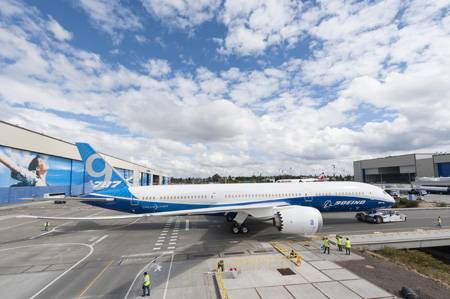
First Boeing 787-9 rolled out to flight line

The Boeing Company has completed the first 787-9 Dreamliner jet. The 787-9 is the second member of the super-efficient 787 family of passenger jets. The new aircraft was rolled out of Boeing's Everett, Wash., factory Saturday to the flight line, where teams are preparing it to fly later this summer.

At 20 feet (6 meter) longer than the 787-8, the 787-9 will extend the 787 family in both capacity and range, carrying 40 more passengers an additional 300 nautical miles (555 kilometers),” Boeing said in a company press release. The 787-9 will burn 20 percent less fuel, releasing fewer emissions than similarly sized airplanes.

With the second and third airplanes in final assembly, Boeing and the 787-9 are on track,” the company said. “First delivery to launch customer Air New Zealand is set for mid-2014.”

Receive DCNewsroom email alerts, subscribe here.

Saturday, August 17, 2013

NTSB releases preliminary data from UPS 1354 crash

National Transportation Safety Board (NTSB) member Robert Sumwalt holds third press briefing on UPS flight 1354 crash in Birmingham, Ala.


Receive DCNewsroom email alerts, subscribe here.

Wednesday, August 14, 2013

Video: NTSB begins investigation of fatal UPS plane crash

The National Transportation Safety Board (NTSB) has launched an investigation into Wednesday morning's crash of United Parcel Service Flight 1354, an Airbus A300 (registration number N155UP), that crashed while on approach to Runway 18 at Birmingham International Airport in Birmingham, Ala.

NTSB Senior Aviation Investigator Dan Bower will serve as investigator-in-charge. NTSB Board Member Robert Sumwalt is accompanying the team and will serve as the principal spokesman during the on-scene phase of the investigation.


Receive DCNewsroom email alerts, subscribe here.

Tuesday, August 13, 2013

Video: RockSat-X experiments launched aboard NASA rocket

A group of experiments developed by university students nationwide were successfully launched into space from Wallops Island, Va. at 6 a.m. EDT Tuesday aboard a NASA Terrier-Improved Malemute suborbital rocket.


Receive DCNewsroom email alerts, subscribe here.

Monday, August 12, 2013

Student space experiments planned for launch from Virginia

A NASA Terrier-Improved Malemute suborbital sounding rocket carrying experiments developed by university students from across the nation is scheduled for launch Tuesday morning from the Wallops Flight Facility in Virginia.

The experiments were developed through the RockSat-X program conducted with the Colorado Space Grant Consortium. The goal of the RockSat-X program is to provide students a hands-on experience in developing experiments for space flight. This experience allows these students to apply what they have learned in the classroom to a real world hands-on activity. Approximately 40 students and instructors will be at Wallops to witness the launch.

The rocket is set for launch between 6 and 10 a.m. EDT.

Receive DCNewsroom email alerts, subscribe here.

Saturday, August 10, 2013

Watch for the Perseid meteor shower this weekend

[UPDATE - 7:37 p.m. EDT] - Meteors showing up on this Ustream broadcast from Valladolid, Spain.

Enjoy a summer evening of sky watching this weekend as the annual Perseid meteor shower peaks Sunday night into Monday morning. Rates can get as high as 100 meteors per hour, with many fireballs visible in the night sky. Early Sunday evening, a waxing crescent moon will interfere slightly with this year's show, but it will have set by the time of the best viewing, just before dawn, Monday morning.

Perseid meteors come across the sky from all directions, a good time to lay back in your favorite lawn chair and look straight up into the dark sky. It is important to be far away from artificial lights, if possible, but not required. Your eyes can take up to 30 minutes to adjust to the darkness, so allow plenty of time for your eyes to “dark-adapt.”

The Perseids have been observed for at least 2,000 years and are associated with the comet Swift-Tuttle, which orbits the sun once every 133 years. Each year in August, the Earth passes through a cloud of the comet's debris. These bits of ice and dust -- most over 1,000 years old -- burn up in the Earth's atmosphere to create one of the best meteor showers of the year.

If cloud cover blocks your view, listen to the Perseid meteors by clicking here.

Schedule of Events

Saturday / 8:12 p.m. EDT – Sunset in Washington, D.C. area.

Saturday / 9:55 p.m. EDT – Moonset in Washington, D.C. area.

Saturday / 11:00 p.m. EDT - Join NASA in a live Web chat to watch the Perseids. NASA astronomer Bill Cooke and Danielle Moser and Rhiannon Blaauw from the NASA Meteoroid Environment Office at Marshall Space Flight Center will answer your questions.

Sunday / 8:11 p.m. EDT – Sunset in Washington, D.C. area.

Sunday / approximately 9:00 p.m. EDT - Live broadcast of the skies over NASA's Marshall Space Flight Center in Huntsville, Ala. begins.

Sunday / 10:28 p.m. EDT – Moonset in Washington, D.C. area.

Receive DCNewsroom email alerts, subscribe here.

Thursday, August 8, 2013

Report released on May 2012 mid-air collision over Warrenton, Va.

Click on image to enlarge.
The Transportation Safety Board of Canada (TSB) released its investigation report Thursday into the mid-air collision between a Piper PA-28 and a Beechcraft Bonanza on May 28, 2012.

"This accident shows once again that the see-and-avoid principle is inadequate for preventing collisions between aircraft flying under visual flight rules (VFR)," said Jon Lee, TSB's Investigator-in-Charge. "Additional defenses must be put in place to prevent mid-air collisions among VFR aircraft."

The Piper (tail number N23C) was registered to and piloted by Federal Aviation Administration (FAA) employee Thomas Proven, and the Beechcraft (tail number N6658R) was registered to and piloted by National Transportation Safety Board (NTSB) employee James Duncan. Given the unique circumstances surrounding the ownership and operation of the aircraft, the TSB accepted delegation of the accident investigation from the NTSB in accordance with international convention.
The Beechcraft was in a shallow climb, headed southbound, being operated VFR for the purposes of a biennial flight review. The Piper was in level flight, under VFR, and was heading in a southeasterly direction. The aircraft collided at approximately 1,800 feet above sea level just after 4 p.m. EDT in the area of Warrenton, Va.

The Beechcraft broke up in flight and the pilot and flight instructor on board were fatally injured. Proven, the sole occupant of the Piper, conducted a forced landing in a pasture approximately six nautical miles south of the Warrenton-Fauquier Airport.

“The TSB remains concerned that yet again, the defenses available to avert a mid-air collision between VFR aircraft in congested airspace have failed,” the board said in their report. “As VFR traffic increases, additional lines of defense should be considered to reduce the risk of a mid-air collision. These include changes in airspace classification, increased air traffic control intervention, ground-based and on board technology.

“A meaningful improvement to the ability to see-and-avoid other VFR aircraft may require on board technology capable of directly alerting pilots to the proximity of conflicting traffic. A number of viable and economical on board alerting systems exist or are under development. Had one or both of these aircraft been equipped with some form of the technology, the risk of collision would have been reduced. The report identified that there is a high risk of mid-air collision in congested airspace when aircraft are not alerted to the presence of another aircraft and rely solely on the see-and-avoid principle.”

Receive DCNewsroom email alerts, subscribe here.